Wednesday, November 13, 2013
The way I see it
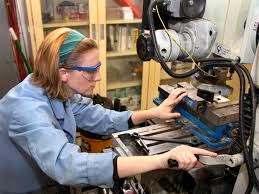
If I was the owner of a business and I asked a photographer
to take some pictures of my factory for a brochure or some kind of promo, I
would like him to show me in his work that my plant is clean, efficient and
well lit, that my equipments are modern and in top conditions and that my
employees are smart and competent. The first thing that I did when I entered
the machine shop was to try to find a way to shoot into a corner. It didn’t matter
if the room was big or not. Shooting into a corner creates some spacial references
and makes any interior look good. Even better there was a machine with lots of
knobs and colorful yellow parts at a perfect angle for what I was trying to execute.
Another element is the verticals; they have to be straight in this type of picture.
I was impressed by the student that posed for me. Carl turned out to be quite a
brilliant young man. He explained to me the functions of the machine and he
told me that he would prefer if possible to be captured operating the mechanism
rather than standing in front of it. I agreed with that. I set up the lights
like in my diagram and the result was I think a well balanced shot. See below for a five photos essay on a Rudyard Kipling poem.
The Secret of the Machines
We were taken from the ore-bed and the mine,
We were melted in
the furnace and the pit—
We were cast and wrought and hammered to design,
Some water and oil is all we ask,
And a thousandth of
an inch to give us play:
And now, if you will set us to our task,
We will serve you
four and twenty hours a day!
But remember, please, the Law by which we live,
We are not built to
comprehend a lie,
We can neither love nor pity nor forgive.
If you make a slip
in handling us you die!
We are greater than the Peoples or the Kings—
Be humble, as you
crawl beneath our rods!-
Our touch can alter all created things,
We are everything on earth—except The Gods!
BY RUDYARD KIPLING
Sunday, November 10, 2013
Fall2013_A#4 Corporate Industrial
Pre
Production Questionnaire
1. What type of available lighting will you be
encountering? Being in a second floor
basement there is no windows and therefore no natural light. This is not an old
factory, the place is well lit. The lights are high enough and are evenly
spread. There is no dark area or corners.
2. What is your intention in terms of how you plan to use
the available light, how will you be addressing the Color Balance for this
mixed light situation? It’s a florescent
light situation. I will use a green gel on the flash.
3. What is the reason for your lens choice? (Do you want the
compression of a long lens or the exaggerated perspective of a wide angle,
fixed focal length or zoom)? I would
like to be able to show the ambiance of the place while concentrating on the
man and the machine. So a long lens with a zoom should be good.
4. What words would you use to describe the Visual Style you
are looking to create in this image? An Industrial photograph that could finds
itself in a company pamphlet or brochure.
5. What aperture do you plan to use and why?
6. What shutter speed to you plan to use and why?
7. What ISO do you plan to use? I already tested my lighting at ISO800,
F/4.2 and 125sec. F/4 is the lowest I could go with the lens I had at the demo
and I manage to get an evenly lit image with these settings.
8. Are there any technical problems that will need to be
addressed at the shoot or any steps you feel will be needed in
post-production? The place could be
cramped, so there could be some changes in the angles of view. There could be
some post or equipment in the way to block the strobes lights. Lighting
equipments from other students could be visible in the background.
9. What equipment you will need for the shoot? 2 strobe lights, one main and one fill. One
softbox and one umbrella. Camera, light stands, grey card, light meter. I will
also bring some gobos and accessories.
10. Who will be your subject and how will they be
represented? A student will be represented
as operating the machinery.
Sunday, November 3, 2013
Self Assessment Fall 2013_A#3 Food Industry Photography.
Food photography….mmmm….food photography. It has to look
good. A nice photo is not enough. When I look at the final picture what do I
say to myself ?... do I want to eat that stuff? So the choice of props or accessories,
the set up and the composition are very important. The Idea that I had of using
the stage worked perfectly for a straight down picture. With the food on the
floor of the stage near the edge I put the softbox level with the composition
and had my tripod also on the stage to give me the equivalent height of around
2 meters. I used a zoom lens and I shot at f11, 1/125th, ISO 100 to
get everything sharp, clean and crisp. I used some reflective cards at various
distances to soften the shadows without getting any flatness. The chosen
picture is the result of the 6th variant of the original
composition.
Wednesday, October 30, 2013
Fall 2013_A#3 Food Industry Photography
I will use the stage to allow me to shoot
straight down on the floor without the use of elaborate scaffolding or ladders.
The large softbox will be set at a 45 degree angle on the main floor offstage
and it will allow me to set the light source level or a little higher than the
food. I will use white and silver
bounce cards to gently fill in any harsh shadows and also to bring details,
ultimately adding more color and texture to the image. The bounce cards are
also important because you should rarely be shooting into direct sunlight. I want
to shoot with the aperture wide open to deliver shallow depth of field and
isolate the food in the frame. Maybee I can achieve a good bokeh intentionally blurring areas of the
image and focusing in the main area of the plate. I will bring a zoom and a prime lens that can
open wide and try something with both. I will shoot at 100 ISO to get maximum
quality.
Sunday, October 6, 2013
Fall 2013 A#2 Outdoor Editorial Portrait
Taken at Dawson college on October 5th 2013.
Nikon D90, Nikkor 18-105mm zoom lens at ISO/100, f/9.0, 1/80 sec.
DAWSON COLLEGE FINE ART ALUMNIE NATALIE NARDOZZA LOOKS BACK:
Natalie is now in her third year
at Concordia University Fine Arts Program. Her major is in Painting &
Drawing. She considers her Dawson
College Fine Art education to be the solid base of her art.
She started off at Dawson
College with only her raw talent. As a student, she acquired new skills along
with all the necessary knowledge and confidence to pursue her aspiration.
Natalie has published her first graphic novel “Dream Catchers” in 2011. It is a
story that is about the life of a high school teen that just happens to have a
wide range of fears. From spiders to heights and more, Al can’t avoid the
nickname kids gave him in school…”Chicken Al”. Things start getting weird for Al when Skelette
and Misère, the two new kids at school tell Al they are Dream Catchers and they
are there to help Al get over her fears before the monsters haunting her
nightmares get out of control.
Natalie is presently working on
her next novel. She considers her Dawson College training as time and effort well
spent that enabled her to become the self-assured Artist/Entrepreneur that she
is today. She markets her art online and at conventions. You can sample some of
her work at
More Images and how different settings gives different results
This picture at ISO/100 40mm f/7.1 and 1/250sec.
Same pose as above but at f/9 and 1/200sec.
A different pose at ISO/100 30mm, f/9 1/80sec.
With the back light to the left ISO/100 35mm, f/9 1/200sec.
Another concept. Overcast sky, one light at ISO/200 85mm f/5.6 1/200sec.
This one at ISO/200 85mm f/8 1/200sec.
Same pose as above but at f/9 and 1/200sec.
A different pose at ISO/100 30mm, f/9 1/80sec.
With the back light to the left ISO/100 35mm, f/9 1/200sec.
Another concept. Overcast sky, one light at ISO/200 85mm f/5.6 1/200sec.
This one at ISO/200 85mm f/8 1/200sec.
This is how I saw it....
I felt quite satisfy with the result of that first try at
what I was trying to achieve. But of course the first time you try something it
is more a discovery process, the second time you quite know where you are going
and on the third time you really are starting to get the exact result that you
are looking for. So I will try to do it again soon. What I really liked about it is the artistry
that comes with adding lights. After the “official” starting point with the
right numbers of ISO/100, f/7.1 and 1/200sec. you can see that by modifying
those settings, changing the position of the lights, the model and the camera
you achieve different results. The fact that we started with a bright sunshine
and ended up with an overcast sky also altered the picture. I used two lights
and a Nikkor 18-105 lens for the wall shots, one light and a Sigma 85mm fix
lens for the garden shots. This type of photography also confuses the auto
settings of the post-processing software so all adjustments have to be done
manually.
Friday, October 4, 2013
Friday, September 20, 2013
Editorial Portrait / New Entrepreneurs, FALL2013 Ass1
This is for an article about the confident modern new entrepreneur women on the go. She is coming out of her hotel heading for a
business meeting, a convention or to the airport to catch a plane. Shot at ISO800, 45mm, f4.8, 1/30th
Subscribe to:
Posts (Atom)


.jpg)
.jpg)
.jpg)
.jpg)
.jpg)
.jpg)